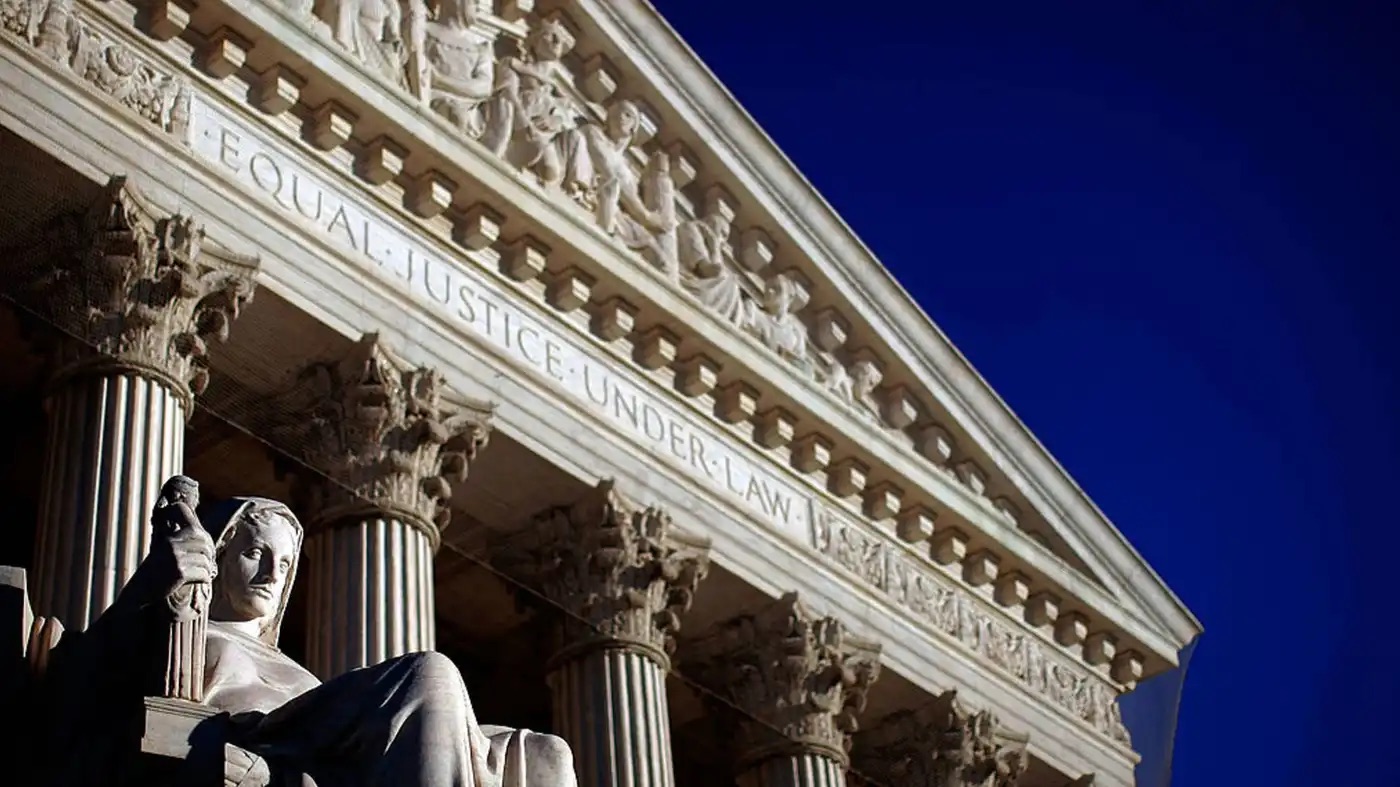
Equal protection under the law— sure, it sounds great in theory, but putting it into practice is a whole different can of worms. In the political and legal environment today, it may be nearly impossible to achieve.
The Founding Fathers envisioned the U.S. Supreme Court as the neutral arbiter of our tripartite system—a concept as noble as it is, quite frankly, adorable in retrospect. As Chief Justice John Marshall famously noted in Marbury v. Madison (1803), it is the “province and duty of the judicial department to say what the law is”. The implication was that they would do so without worrying about their public image or the political background of their nominators.
As we look at the historical arc of the Court and its relationship with the Voting Rights Act (VRA), it becomes clear that while the judiciary is tasked with protecting democracy, it has also become the primary stage for the very political theatrics it was meant to rise above.
The VRA: A Long, Bloody Road to the Ballot Box
Before we wring our hands over current confirmation hearings, it is worth remembering that the “neutral” Court hasn’t always been the hero of the story. The history of Black voting rights is a cycle of promise and catastrophic collapse. Following the brief springtime of Reconstruction, the “Nadir” of the 1890s saw literacy tests, poll taxes, and violence dismantle the 14th and 15th Amendments.
It took the strategic brilliance of the Selma campaign and the subsequent national outrage to push the VRA into existence in 1965. The Act was a masterstroke:
Section 5 (Preclearance): Forced jurisdictions with a history of discrimination to ask for permission before changing voting laws.
Immediate Results: Mississippi saw Black registration jump from 6.7% to 59.8% in just two years.
Judicial Intervention: The Court, specifically in Allen v. State Board of Elections (1969), actually helped by recognizing that “vote dilution” (gerrymandering, at-large elections) was just as harmful as outright disenfranchisement.
The Modern “Danger to Democracy”
Fast forward to the 21st century, and the tone of the Court has shifted from legal arbiter to political battleground. Academic commentary highlights a grim reality: the confirmation process, once a relatively polite affair, has morphed into a high-stakes, hyper-polarized cage match.
We are currently witnessing a “dangerous” trend where presidents get to reshape the Court for decades. The speed of recent nominations has led scholars to argue that our tripartite system is in genuine jeopardy. When the confirmation of a justice is viewed as a “seismic event” for one political party and a “stunning defeat” for the other, it’s hard to pretend the Court is functioning as the founders intended. The result? Public approval of the Supreme Court has plummeted, with recent polls showing only 37% of Americans expressing strong confidence in the institution.
Does the VRA Still Work?
If the high-level politics of the Court are in a “broken” state, one might assume the VRA’s legacy is effectively dead. Interestingly, the data suggests a more nuanced story.
Research indicates that despite the “prevailing culture of white supremacy” and the difficulty of navigating a hostile judiciary, the VRA actually did foster Black office holding in the Deep South. Even when people were questioning the Act’s efficacy in the 1970s, evidence shows it spurred the election of Black commissioners, particularly in counties that used single-member districts rather than at-large elections. These gains were not just for symbolic, minor offices; they extended to powerful county commissions that control local public finances.
The Verdict
The Supreme Court is currently navigating a period of intense polarization, where the threat of a constitutional crisis feels more like a daily occurrence than a theoretical exercise. The recent ruling in Louisiana v. Callais (2026) serves as a stark reminder that the current Court is not merely an indifferent arbiter, but an active participant in weakening the structural integrity of the Voting Rights Act. By prioritizing procedural technicalities over the substantive right to fair representation, this holding demonstrates a troubling willingness to erode the very protections designed to ensure democratic access.
The history of the VRA teaches us two conflicting lessons:
1) The Court is not a magic wand. Legislation is only as effective as the political will to enforce it, and the judiciary is often a reflection of the political party currently holding the pen.
2) Institutional pressure works. Even in a flawed system, mechanisms like preclearance and legal challenges have successfully dismantled barriers to entry and carved out actual political power for marginalized groups.
The judiciary might be getting more politicized, and the confirmation process might be getting more absurd, but the work of protecting the franchise remains as grinding and necessary as it was in 1965. Perhaps the best we can hope for is that the Court is forced to reconsider its trajectory as public scrutiny mounts—otherwise, we risk watching the last of our voting safeguards be dismantled by the gavel.
Sources
Lawson, C. F. (2003). How Race Becomes Inequality: The Voting Rights Act and the Politics of Representation.
Levitsky, S., & Ziblatt, D. (2018). How Democracies Die.
Garrow, D. J. (1978). Protest at Selma: Martin Luther King, Jr., and the Voting Rights Act of 1965.
Hanes, W., & Grofman, B. (2009). The Voting Rights Act and the Evolution of Black Electoral Success in the South.
Marbury v. Madison, 5 U.S. 137 (1803).
Allen v. State Board of Elections, 393 U.S. 544 (1969).
Louisiana v. Callais, 601 U.S. ___ (2026).


Leave a Reply